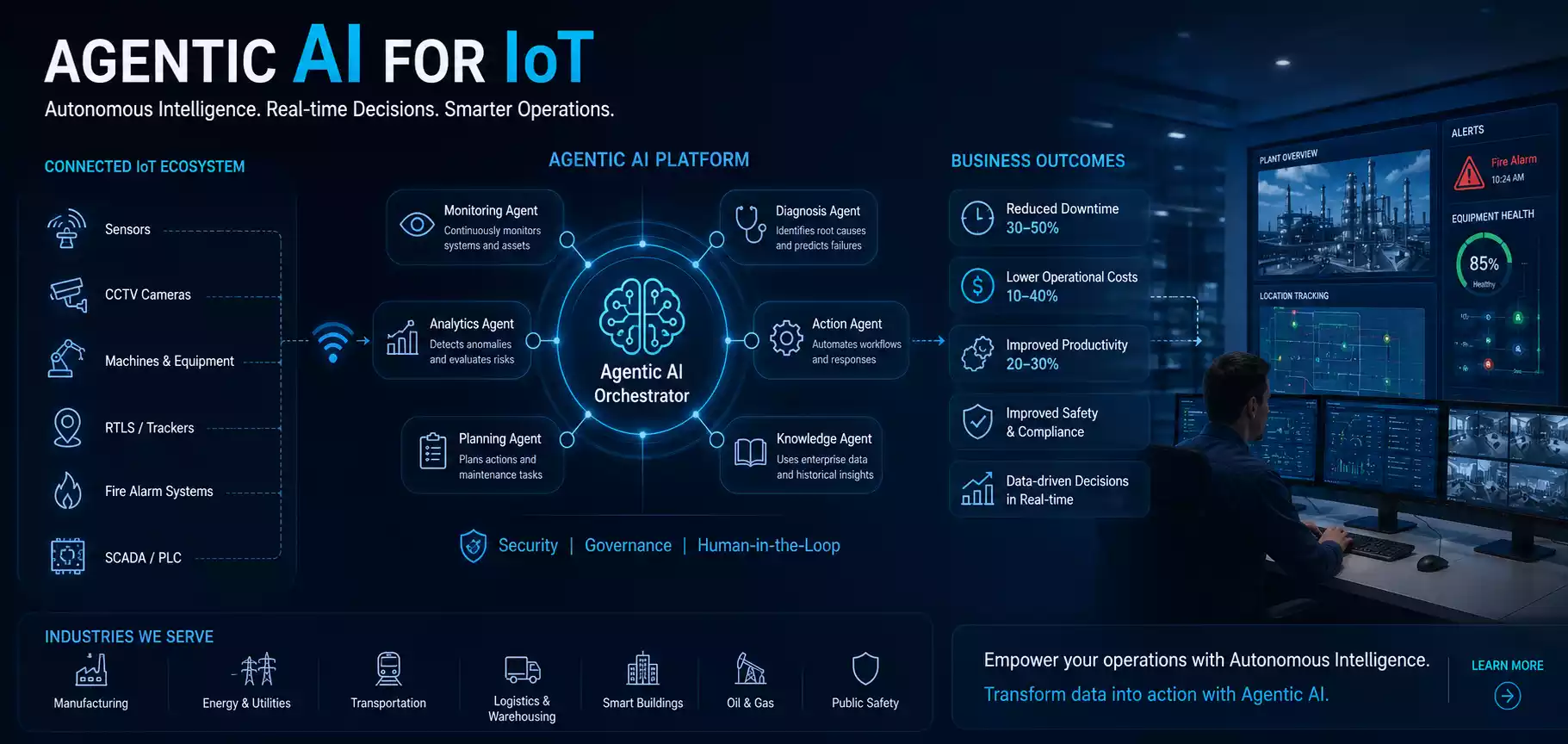
Industrial organizations are creating more data than ever. This comes from Industrial IoT. It links machines, sensors, cameras, vehicles, and operational technology (OT). Many businesses still rely on engineers to check dashboards, look into alarms, and make important decisions. Agentic AI transforms this by quickly turning real-time IoT data into smart operational decisions.
Industry research shows that predictive maintenance can cut unplanned downtime by 30–50%. It can also lower maintenance costs by 10–40% and extend equipment life by 20–40%. Agentic AI for IoT works with Computer Vision, RTLS, and enterprise systems. This helps organizations boost efficiency, resilience, and long-term ROI.
Why Agentic AI Matters for Enterprise IoT
Industrial organizations are creating more data than ever. This comes from Industrial IoT. It links machines, sensors, cameras, vehicles, and operational technology (OT). Many businesses still rely on engineers to check dashboards, look into alarms, and make important decisions. Agentic AI transforms this by quickly turning real-time IoT data into smart operational decisions.
Industry research shows that predictive maintenance can cut unplanned downtime by 30–50%. It can also lower maintenance costs by 10–40% and extend equipment life by 20–40%. Agentic AI for IoT works with Computer Vision, RTLS, and enterprise systems. This helps organizations boost efficiency, resilience, and long-term ROI.
1. Agentic AI for Fire Safety Intelligence
Fire protection systems in factories, warehouses, hospitals, airports, and commercial buildings trigger thousands of alarms each year. Many issues come from equipment faults, communication errors, or environmental conditions. They aren't real emergencies. Every false alarm consumes valuable time and operational resources.
Agentic AI boosts fire safety by linking data from various sources. It has fire alarm panels. It uses smoke and heat detectors. It features Smart CCTV. There are electrical temperature sensors. Maintenance records are also included. This data helps identify issues before they become serious. It doesn't just respond to one alarm. It checks sensor health. It looks at past patterns. Then, it confirms visual evidence with Computer Vision. Then, it evaluates the operational risk.
The system can automatically:
- Retrieve emergency procedures
- Recommend response actions
- Notify relevant personnel
- Generate incident reports
It also checks detector health and spots equipment that may be failing. This helps with predictive maintenance before problems happen.
Potential Benefits
| Area |
Business Value |
| False alarm investigations |
Reduced through multi-source validation |
| Emergency response |
Faster incident verification |
| Equipment reliability |
Earlier fault detection |
| Compliance |
Better documentation and audit readiness |
| Safety |
Improved situational awareness |
Industries: Manufacturing, logistics, airports, healthcare, smart buildings, education, utilities.
2. Agentic AI for Predictive Maintenance
Unexpected equipment failures remain one of the largest sources of operational disruption across manufacturing, utilities, transportation, and energy sectors.
Traditional maintenance is typically reactive or based on fixed schedules. Neither approach reflects the actual condition of industrial assets.
Agentic AI checks vibration, temperature, pressure, current use, runtime, and maintenance history. It does this to assess the health of the equipment. AI agents team up to identify possible failures. They estimate Remaining Useful Life (RUL) and find root causes. Then, they suggest the best maintenance schedule to save costs.
Agentic AI goes beyond just predicting motor failures. It looks at production schedules, spare parts, workforce capacity, and operational risk. Then, it recommends the best action. Approved maintenance activities can then be automatically synchronized with CMMS and ERP systems.
Business Impact
| KPI |
Typical Improvement |
| Unplanned downtime |
↓ 30–50% |
| Maintenance costs |
↓ 10–40% |
| Equipment lifetime |
↑ 20–40% |
| Spare parts inventory |
↓ 10–20% |
| Maintenance productivity |
↑ 20–30% |
For organizations managing thousands of industrial assets, these improvements translate into lower operating costs, greater equipment availability, and improved production efficiency.
Industries: Manufacturing, oil & gas, utilities, mining, transportation, ports.
3. Agentic AI for Real-Time Asset Tracking & Workforce Safety
Large industrial facilities often have trouble finding equipment. They also struggle to track workforce movement and ensure safety compliance.
Modern RTLS platforms use LoRaWAN, Ultra-Wideband (UWB), GPS, and BLE technologies. They provide continuous location data for both assets and personnel. Agentic AI transforms this location data into operational intelligence.
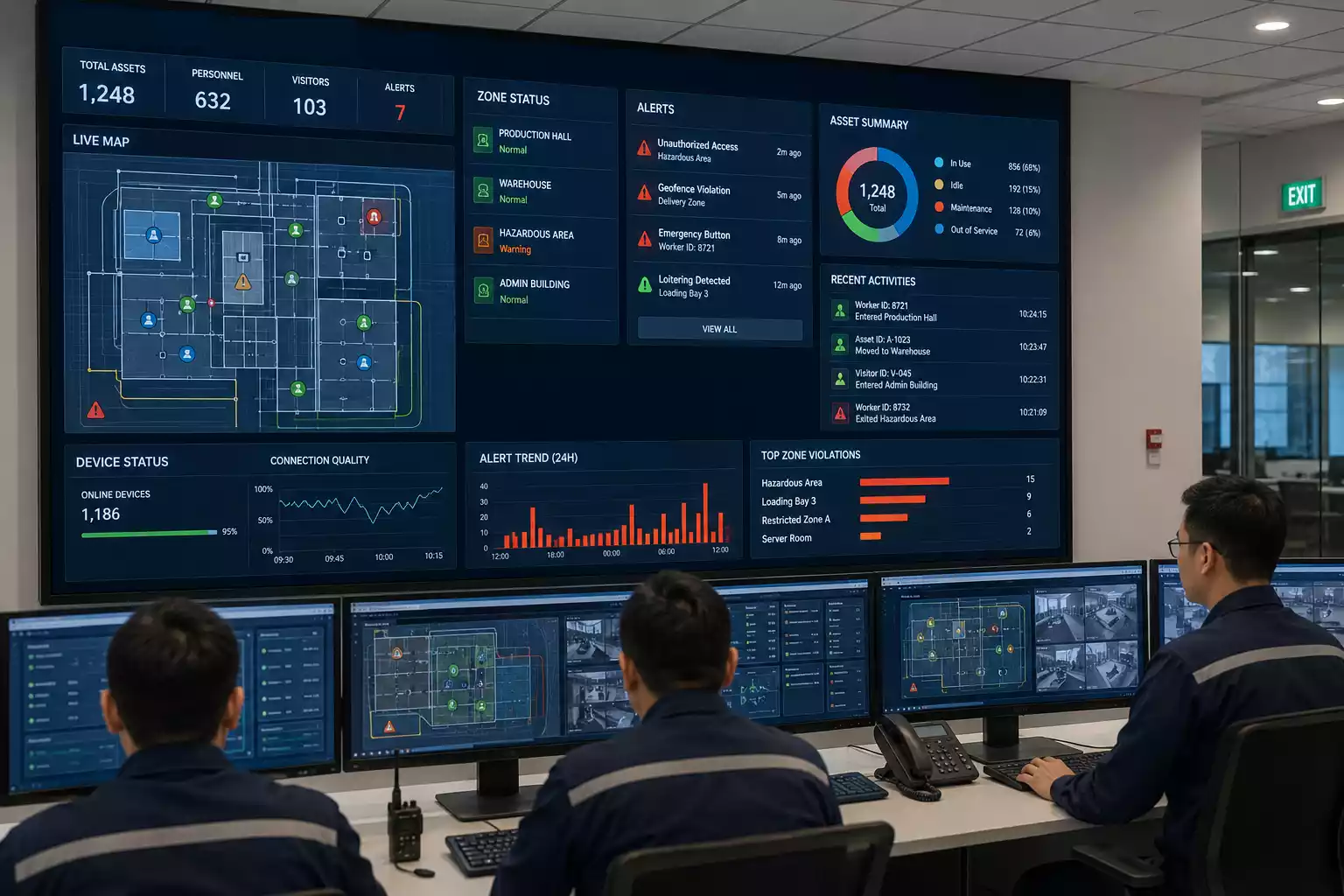
Agentic AI does more than show where an asset is. It looks at how assets are used, spots unauthorized movement, and finds workers in restricted areas. Then, it suggests actions based on what’s most important for operations.
If a technician goes into a hazardous area without permission, the platform can quickly check their identity. It can also find safety procedures, alert supervisors, and suggest the best evacuation route. Simultaneously, nearby autonomous vehicles or forklifts can be rerouted to reduce operational risk.
Business Value
| KPI |
Operational Benefit |
| Asset search time |
Significant reduction |
| Equipment utilization |
Higher utilization rates |
| Emergency response |
Faster coordination |
| Asset loss |
Reduced through continuous visibility |
| Safety compliance |
Improved geofencing and access monitoring |
By combining RTLS with Agentic AI, organizations move beyond tracking toward intelligent workforce and asset management.
Industries: Warehousing, logistics, manufacturing, healthcare, mining, construction, airports.
4. Agentic AI for Smart CCTV & Computer Vision
Traditional CCTV systems are designed primarily for monitoring and recording events. AI-powered video analytics can spot motion, people, or vehicles. However, many systems still send separate alerts. Operators must then decide if an incident is real.
Agentic AI turns Smart CCTV into an active operational assistant, not just a monitoring tool. AI agents can combine Computer Vision with IoT sensors, RTLS, access control systems, and enterprise data. This helps them grasp the context of an event, not just detect it.
If smoke is found near an electrical cabinet, the system checks nearby temperature sensors. It also looks at maintenance history, electrical load, and past inspection reports. Then, it decides the risk level. It creates a prioritized incident instead of setting off many alarms. It suggests the right response and alerts the maintenance or security teams.
This coordinated method cuts down on needless investigations. It also boosts operational awareness throughout the facility.
Business Value
| Traditional CCTV |
Agentic AI Smart CCTV |
| Passive video recording |
Intelligent event investigation |
| Manual monitoring |
Automated incident analysis |
| Single-camera alerts |
Multi-source validation |
| Post-event investigation |
Real-time operational decisions |
| Limited operational context |
Enterprise-wide situational awareness |
Industries: Manufacturing, logistics, smart cities, airports, healthcare, commercial buildings, critical infrastructure.
5. Agentic AI for Tunnel Ventilation Reliability
Tunnel ventilation systems play a critical role in maintaining air quality and public safety. Equipment like jet fans, ventilation motors, air quality sensors, and Variable Frequency Drives (VFDs) run all the time in tough conditions. Unexpected failures can disrupt traffic and raise maintenance costs.
Traditional maintenance depends on scheduled inspections or repairs after equipment has worn down. Agentic AI takes a proactive approach. It continuously checks equipment health. It uses data from IoT sensors, SCADA systems, maintenance records, and environmental conditions.
The system checks vibration patterns, motor temperature, power use, and past behavior. This helps it estimate the Remaining Useful Life (RUL) of the ventilation fan. So, it can suggest maintenance before a failure happens.
Schedule maintenance during planned shutdowns. This reduces disruption and helps extend equipment life.
Expected Outcomes
| Objective |
Operational Benefit |
| Equipment failures |
Reduced through early detection |
| Maintenance planning |
Optimized using asset condition |
| Infrastructure availability |
Higher operational uptime |
| Asset lifespan |
Extended through predictive maintenance |
| Public safety |
Earlier identification of critical issues |
Industries: Transportation, tunnels, rail infrastructure, highways, utilities, smart cities.
Simplified Enterprise Architecture
Successful Agentic AI deployments do not require organizations to replace existing infrastructure. Agentic AI is an intelligent layer. It connects operational systems, enterprise applications, and AI agents.
A typical architecture consists of four core layers:
Data Collection
- IoT sensors
- LoRaWAN devices
- UWB RTLS
- GPS trackers
- Smart CCTV
- PLCs
- SCADA
- Building Management Systems
Data Integration
Enterprise data connects using standard protocols like MQTT, OPC UA, and REST APIs. It also links with existing platforms such as ERP, MES, and CMMS.
AI Agent Layer
Specialized AI agents do many tasks. They monitor equipment and check for issues. They also gather company knowledge, predict failures, and suggest actions. Plus, they automate workflows that are approved.
Human Oversight
Human control handles safety-critical decisions. Routine tasks like monitoring, reporting, diagnostics, and workflow automation can run on their own.
This modular design helps organizations expand Agentic AI in many locations. They can also use their current IoT investments.
Why Enterprises Are Investing in Agentic AI
Industrial organizations are shifting from traditional dashboards to AI systems. These systems actively help with operational decision-making.
The growing adoption of Agentic AI is driven by measurable business outcomes rather than technology alone.
| Business Objective |
How Agentic AI Delivers Value |
| Reduce downtime |
Predict failures before breakdowns |
| Improve productivity |
Automate investigations and reporting |
| Increase asset utilization |
Optimize equipment usage |
| Enhance worker safety |
Detect hazards and coordinate responses |
| Improve decision-making |
Deliver AI-generated operational insights |
| Lower operating costs |
Optimize maintenance and resource allocation |
| Strengthen compliance |
Automate documentation and audit support |
Organizations are investing in Industrial IoT. Agentic AI boosts the value of current infrastructure. It turns operational data into smart actions.
How Affirmo Technology Can Help
Agentic AI works best when it has a strong base. This includes connected devices, reliable data, and scalable enterprise integration.
Affirmo Technology helps organizations build a strong foundation. They use LoRaWAN GPS tracking, Ultra-Wideband (UWB) indoor positioning, Smart CCTV, and an AI-powered IoT Data Platform. This platform centralizes operational data from many sources.
Depending on business requirements, Affirmo can help organizations:
- Design scalable IoT and AI architectures
- Integrate sensors, RTLS, Smart CCTV, and enterprise systems
- Build AI-enabled operational dashboards
- Implement predictive maintenance and asset intelligence
- Develop multi-agent workflows for industrial automation
- Integrate with ERP, CMMS, SCADA, PLC, and cloud platforms
- Support cloud or on-premises deployments
Affirmo helps organizations boost asset visibility, enhance workplace safety, and modernize operations. They create IoT and AI solutions that fit each organization's goals.
Ready to explore Agentic AI for your business? Contact Affirmo Technology to talk about your operational challenges. Find out how smart IoT solutions can enhance efficiency. They also improve visibility and help with decision-making in your organization.