Banks across Singapore, Malaysia, Indonesia, Thailand, Vietnam, and the Philippines are facing rising customer expectations, increasing fraud risks, and stricter regulatory requirements while still relying on many manual processes.
Affirmo Technology can design, integrate, and implement Agentic AI solutions that help banks improve customer service, strengthen compliance, enhance fraud detection, and streamline lending operations with human oversight.
Current Banking Challenges
| Business Area |
Typical Challenge |
Operational Impact |
| Customer Service |
High enquiry volumes |
Longer waiting times |
| KYC |
Manual document verification |
Delayed onboarding |
| AML |
High volume of alerts |
Increased analyst workload |
| Fraud Detection |
Rule-based monitoring |
Higher false positives |
| Loan Processing |
Manual document review |
Longer approval cycles |
| Compliance |
Multiple regulatory checks |
Increased operational complexity |
| Back Office |
Repetitive administrative work |
Higher operating costs |
| Knowledge Access |
Information stored in silos |
Inconsistent customer responses |
How Agentic AI Works in Banking
Unlike a traditional chatbot, Agentic AI for Banking combines multiple specialized AI agents that collaborate across banking operations from customer onboarding to fraud detection and loan approvals.
Customer Service Agent
Acts as the first point of contact by providing AI Customer Service across mobile banking, internet banking, contact centres, and branch support.
Loan Processing Agent
Supports Loan Processing Automation by verifying applications, analysing supporting documents, retrieving credit information, and preparing recommendations for lending officers.
KYC & Document Intelligence Agent
Automates KYC Automation by extracting and validating customer identity documents, income records, and business registrations using OCR, Document Intelligence, and Large Language Models (LLMs).
Risk Assessment Agent
Evaluates customer credit profiles, financial history, liabilities, and other risk factors to provide structured insights that support faster and more consistent lending decisions.
Fraud Detection Agent
Continuously monitors transactions and customer behaviour to identify suspicious activities, detect anomalies, assign risk scores, and support fraud investigators with prioritized alerts.
Enterprise Knowledge Agent
Provides employees with instant access to internal policies, product information, operating procedures, and regulatory guidelines using semantic search, Enterprise Search, and Retrieval-Augmented Generation (RAG).
Compliance Agent
Assists compliance teams by supporting AML Automation, performing KYC verification, identifying missing documents, and preparing compliance summaries for human review.
Workflow Orchestration Agent
Coordinates the entire process by determining which AI agent should act next, sharing information between systems, triggering approvals when required, and ensuring every workflow follows predefined business rules.
Together, these AI agents create an intelligent, connected banking ecosystem that improves operational efficiency while keeping people in control of critical business decisions.
Human-in-the-Loop Governance
Enterprise banking requires accountability. For this reason, AI should augment rather than replace employees.
Human approval remains appropriate for activities such as:
- High-value loan approvals
- Suspicious AML investigations
- Regulatory reporting
- High-risk customer onboarding
- Escalated fraud investigations
This approach supports AI Governance and Responsible AI principles. While maintaining transparency and auditability.
Example Banking Workflow
The following example illustrates how AI Banking Solutions can automate a typical home loan application while maintaining human oversight.
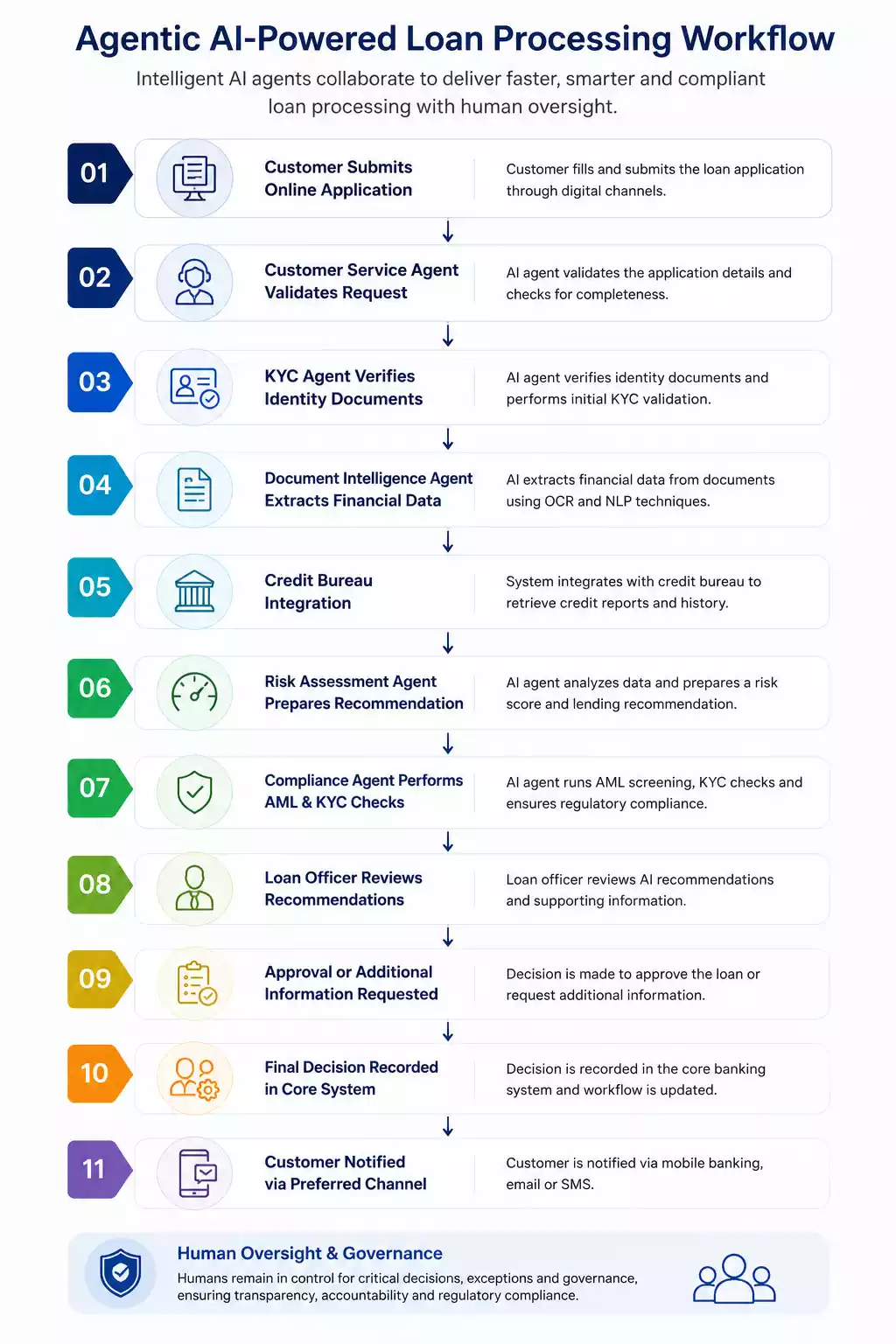
Example Banking Workflow
One of the strengths of Agentic AI is its ability to integrate with existing banking infrastructure rather than replacing core platforms. A typical architecture may include the following enterprise systems.
| Enterprise System |
Possible AI Integration |
| Core Banking System |
Customer accounts, balances, transactions |
| CRM |
Customer profiles and relationship history |
| Internet Banking |
Customer self-service workflows |
| Mobile Banking |
AI-powered customer interactions |
| Payment Gateway |
Transaction monitoring |
| AML Platform |
Compliance workflow automation |
| KYC Database |
Identity verification |
| Document Management System |
Document retrieval and analysis |
| Enterprise Knowledge Base |
Policy and procedure search |
| Email Platform |
Automated customer communications |
| Call Centre Platform |
AI-assisted customer support |
| ERP (where applicable) |
Procurement and finance workflows |
Modern deployments typically communicate through secure API Integration, allowing AI agents to exchange information without disrupting existing banking operations.
Depending on an organisation's technology strategy, the solution may be deployed on Microsoft Azure, AWS, Google Cloud, private cloud infrastructure, or on-premises environments while supporting enterprise security requirements such as PCI DSS, ISO 20022, SWIFT integration, role-based access control, encryption, and audit logging.
Industry Benchmarks
While results vary between institutions, independent industry studies consistently report measurable improvements following enterprise AI adoption.
| Operational Area |
Typical Industry Improvement* |
| Customer onboarding |
20–40% faster |
| Loan processing |
30–50% quicker |
| Customer response time |
30–50% faster |
| Manual administrative work |
20–35% reduction |
| Operational costs |
15–30% lower |
| Fraud investigation prioritisation |
Improved detection accuracy and reduced false positives |
| Employee productivity |
Higher throughput through AI-assisted workflows |
These improvements are commonly reported across Financial Services organizations implementing Business Process Automation and enterprise AI technologies.
Expected Business Outcomes
While results vary between institutions, independent industry studies consistently report measurable improvements following enterprise AI adoption.
| Operational Area |
Typical Industry Improvement* |
| Customer onboarding |
20–40% faster |
| Loan processing |
30–50% quicker |
| Customer response time |
30–50% faster |
| Manual administrative work |
20–35% reduction |
| Operational costs |
15–30% lower |
| Fraud investigation prioritisation |
Improved detection accuracy and reduced false positives |
| Employee productivity |
Higher throughput through AI-assisted workflows |
These improvements are commonly reported across Financial Services organizations implementing Business Process Automation and enterprise AI technologies.