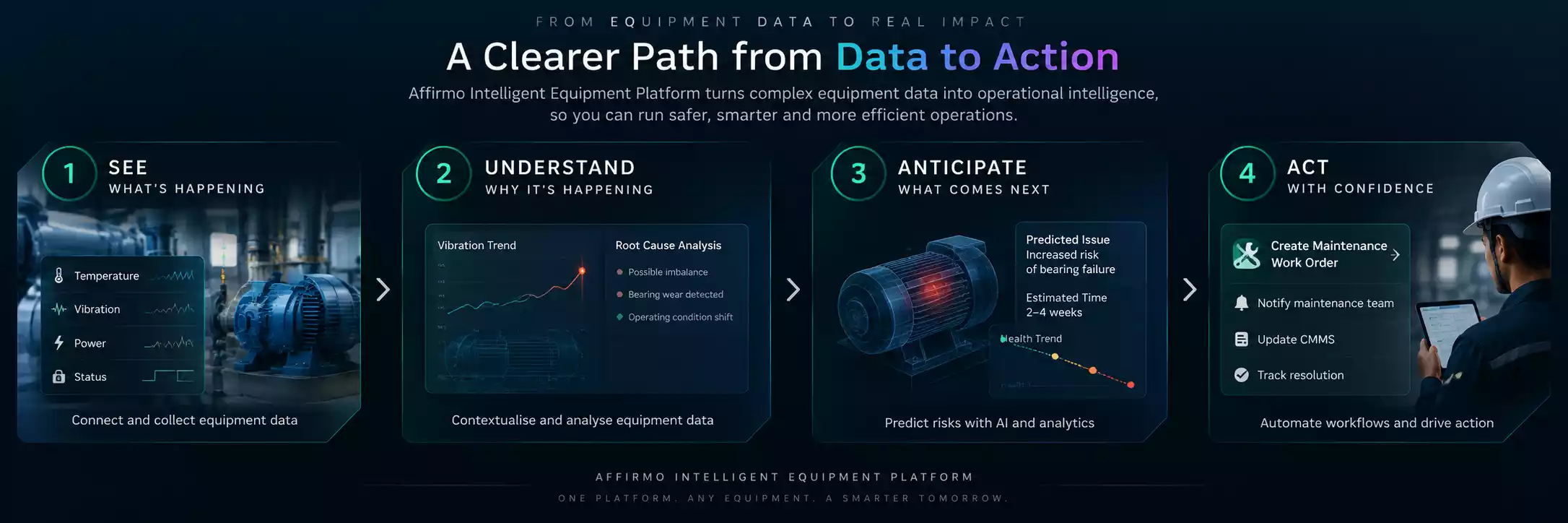
Modern facilities rely on hundreds or thousands of pumps, generators, motors, compressors, HVAC systems, and other connected assets, generating valuable operational data. Yet that data often remains fragmented across equipment, systems, and vendors. The challenge is no longer simply collecting data, but turning it into intelligence that operations and maintenance teams can act on.
Affirmo Intelligent Equipment Platform provides a vendor-neutral, API-first foundation to connect, centralise and contextualise equipment data through an Industrial IoT platform for real-time equipment monitoring, analytics, predictive maintenance and AI.
The Problem with Fragmented Equipment Data
A modern facility can contain equipment from many manufacturers, installed at different times and connected through different systems. Data may sit across BMS, SCADA, EMS, work-order systems, equipment controllers, IoT gateways and vendor-specific applications.
This creates a familiar operational problem: organisations may have plenty of data but limited equipment-level context.
Common challenges include:
- Siloed equipment and facility systems
- Incompatible protocols and interfaces
- Manual inspections and records
- Isolated dashboards
- Limited access to historical equipment behaviour
- Difficulty sharing operational data between departments
- Dependence on proprietary integrations
- Delayed investigation and maintenance decisions
Affirmo's source material identifies fragmented systems, incompatible protocols, vendor lock-in, regulatory reporting demands and delayed decisions as key challenges in smart facilities environments.
The objective is not necessarily to replace all these systems. It is to create a common data and intelligence layer that can work with the infrastructure an organisation already has.
From Equipment Data to Equipment Intelligence
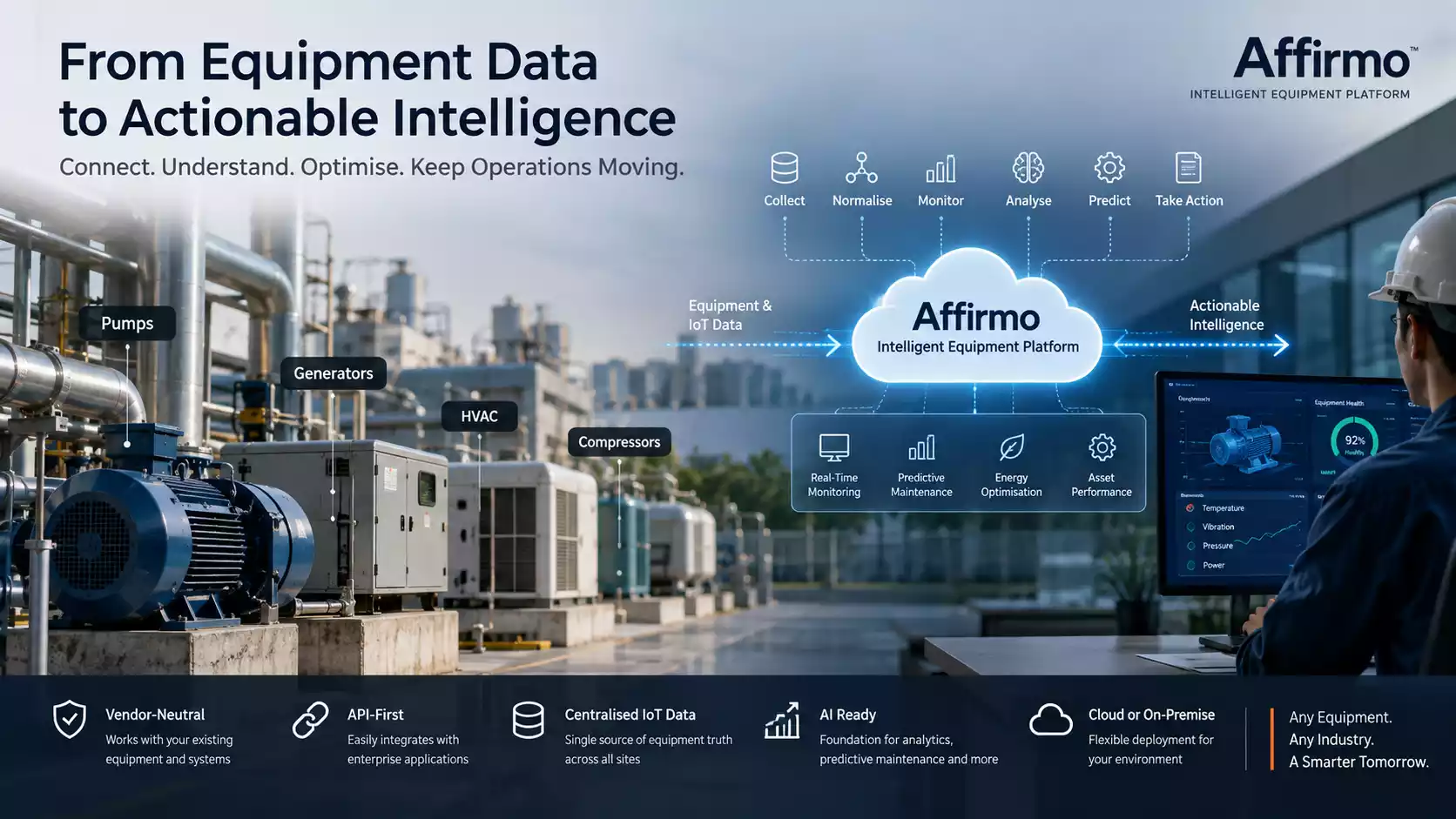
Raw machine data is useful, but data contextualization makes it significantly more useful.
Consider a motor producing a temperature reading. A standalone value tells an engineer very little. When that reading is associated with the specific motor, its operating state, historical trends, related vibration data and previous alarms, it becomes equipment intelligence.
At its core, the Affirmo Intelligent Equipment Platform acts as a centralized and normalized IoT data store. It brings equipment and IoT data from different sources into a common environment where the information can be structured, contextualized and made available for monitoring, analytics, AI and predictive maintenance.
At its core, the Affirmo Intelligent Equipment Platform acts as a centralized and normalized IoT data platform and IoT data storage platform. It brings industrial equipment data and IoT data from different sources into a common environment where the information can be structured, contextualized and made available for monitoring, analytics, AI and predictive maintenance.
The architecture can be represented as:
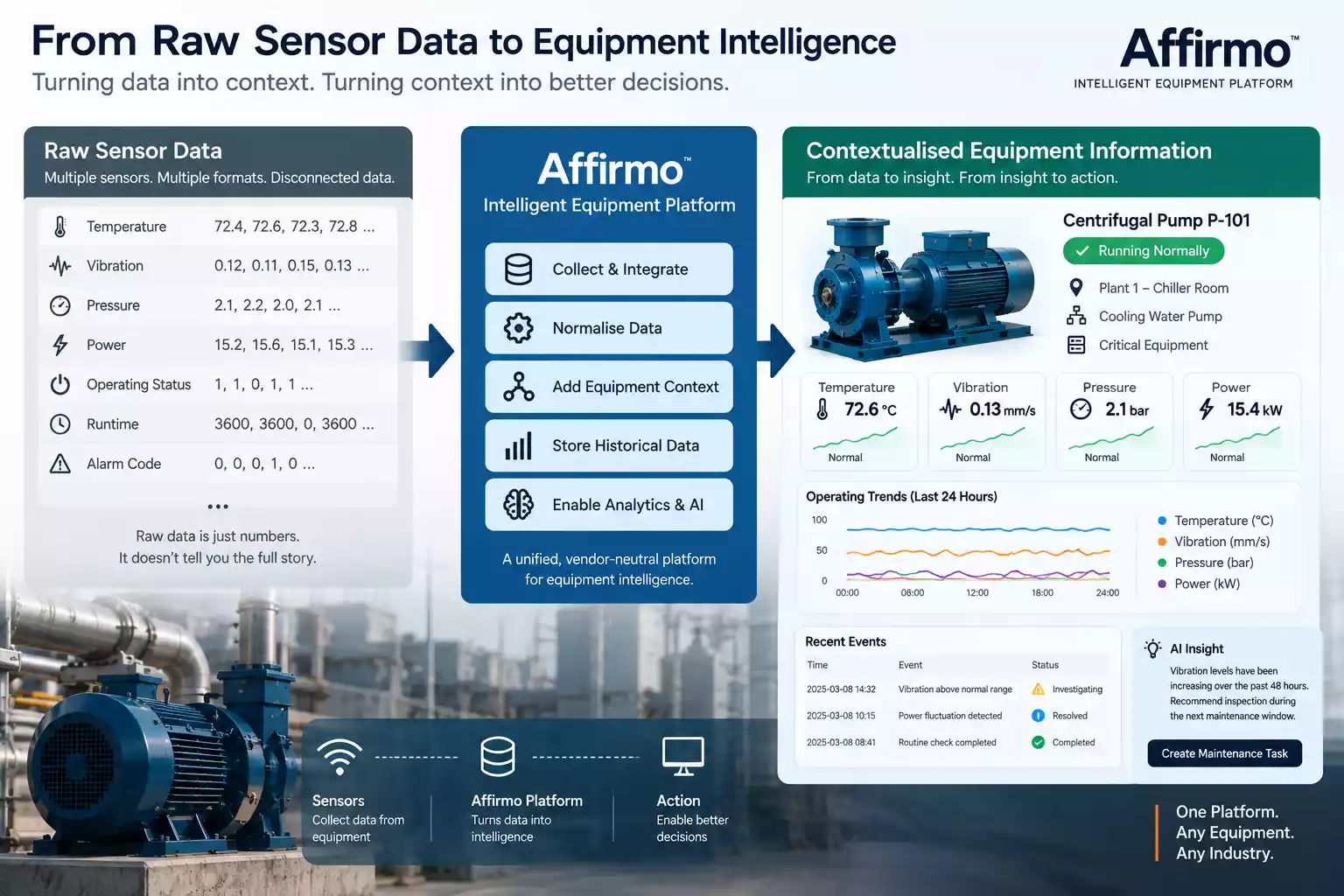
The Affirmo platform is designed around this progression, moving organisations from knowing what is happening toward understanding why it is happening, predicting what may happen next and determining what action may be appropriate.
This distinction matters because an enterprise equipment platform should not simply become another dashboard. It should make data understandable in the context of the physical assets generating it.
What Makes an Intelligent Equipment Platform Different?
Stage
|
What Happens
|
Enterprise Value
|
| Data Collection |
Sensors and equipment generate telemetry |
Captures operational data |
| Data Normalisation |
Data from different sources is structured |
Creates consistency |
| Equipment Context |
Makes readings meaningful for asset performance and equipment health |
Makes readings meaningful |
| Monitoring |
Conditions, thresholds and alarms are tracked through real-time equipment monitoring |
Provides real-time visibility |
| Analytics |
Historical and current data are analysed for equipment performance monitoring |
Identifies patterns and anomalies |
| Predictive AI |
Equipment behaviour is analysed for future conditions and equipment diagnostics |
Supports predictive maintenance |
| Agentic AI |
AI agents reason and coordinate workflows |
Supports intelligent action |
Vendor-Neutral Architecture
Industrial organisations rarely operate a single equipment ecosystem. A vendor-neutral IoT platform can provide a common layer across equipment and systems from different suppliers.
This approach can also reduce the need to redesign the entire technology environment whenever a new equipment type or application is introduced.
API-First Design
Equipment data becomes more valuable when it can be accessed by applications beyond the original monitoring system.
Affirmo's platform is designed with open APIs so organisations can access IoT data and build their own dashboards, applications and analytics while continuing to use existing enterprise systems.
Centralised Equipment Data
A centralised IoT data platform provides a common location for device, asset and telemetry information and supports enterprise IoT data management. Historical data can then be retained for reporting, investigation, trend analysis and AI applications.
For enterprises managing equipment across multiple systems and locations, a centralized and normalized IoT data store provides a common foundation for managing operational data. Rather than keeping telemetry isolated within individual applications, the platform can bring relevant equipment data together for analysis, reporting and downstream applications.
Equipment Context
Instead of treating every sensor as an isolated data source, the platform organises information around the physical equipment it represents.
That allows teams to examine equipment health, operating trends, availability, alarms and historical performance rather than individual sensor readings. This provides a stronger foundation for asset performance management and equipment-level decision-making.
Key Capabilities of the Affirmo Intelligent Equipment Platform
Connect and Collect
The platform can connect equipment and IoT sensors through appropriate connectivity and integration mechanisms. Depending on the environment, this can include LoRaWAN, MQTT, REST APIs and existing industrial interfaces, supporting IoT/OT/IT integration across equipment, operational technology and enterprise systems.
The exact architecture should be determined by the customer's equipment, connectivity and enterprise systems.
IoT Data Normalisation
Equipment from different manufacturers can produce equipment data in different formats and structures. IoT data normalization helps create a consistent foundation for monitoring and analysis.
This becomes particularly important when an organisation wants to analyse equipment across multiple facilities rather than within a single vendor ecosystem.
Centralised IoT Data Platform
Affirmo's platform provides a centralised foundation for registering devices and assets, storing telemetry and retaining historical information for analysis and reporting.
Real-Time Equipment Monitoring
Monitoring can provide visibility into equipment status and sensor conditions, supporting equipment condition monitoring with configurable thresholds, rules, alarms and notifications for abnormal conditions.
Asset and Equipment Intelligence
The important step is moving from "sensor monitoring" to "equipment understanding". This approach supports industrial equipment monitoring by connecting individual sensor readings with the operational context of the asset.
A maintenance team can examine operating trends, equipment availability, alarm history and historical performance in one context rather than manually assembling information from several systems. This helps teams understand asset performance and identify changes that may require further investigation.
IoT Data API
The IoT data API allows equipment information to become part of broader enterprise workflows. Data can be made available to custom applications, dashboards and analytics without making the equipment platform the only interface to the data.
Analytics and AI Readiness
Structured and contextualised equipment data provides the foundation for anomaly detection, predictive maintenance, predictive AI, energy optimisation, equipment diagnostics, AI-assisted diagnostics and Agentic AI.
Equipment Intelligence Use Cases
Equipment / Environment
|
Data Sources
|
Intelligence Application
|
Potential Operational Outcome
|
| Pumps |
Vibration, temperature, pressure |
Condition monitoring |
Earlier identification of abnormal conditions |
| Motors |
Temperature, vibration, power |
Equipment health and asset performance analysis |
Better maintenance prioritisation |
| HVAC / Chillers |
Temperature, operating status, energy |
Performance and energy analysis |
Identification of optimisation opportunities |
| Generators |
Runtime, temperature, alarms |
Health monitoring and predictive analysis |
Improved maintenance planning |
| Industrial Machinery |
Sensor telemetry, operating data, alarms |
IoT predictive maintenance and predictive maintenance |
Reduced risk of unplanned disruption |
| Building Equipment |
IoT sensors, BMS data, equipment status |
Centralised equipment intelligence |
Better operational visibility |
| Equipment / Environment |
Data Sources |
Intelligence Application |
Potential Operational Outcome |
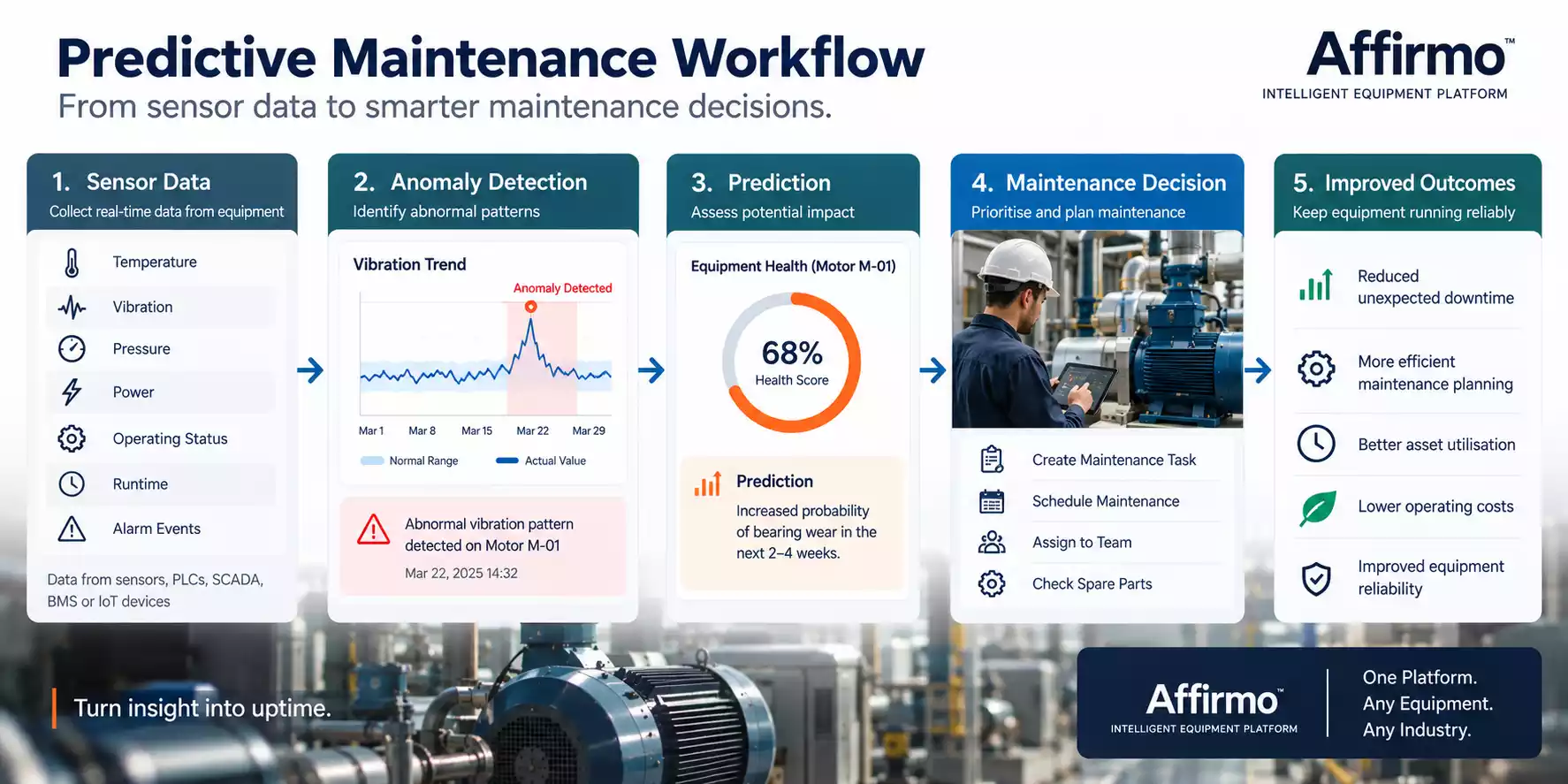
Predictive Maintenance
Predictive maintenance depends on more than a machine-learning model. It requires reliable historical equipment data, consistent telemetry and sufficient context to understand normal and abnormal behaviour.
An Industrial IoT platform can provide the underlying data layer for:
- Condition monitoring
- Anomaly detection
- Failure prediction
- Remaining Useful Life analysis
- Maintenance prioritisation
- Maintenance planning
- Maintenance scheduling
This creates a progression from reactive maintenance toward condition-based and predictive maintenance.
Equipment Health Monitoring
Continuous equipment health monitoring can reduce dependence on periodic inspection alone.
Instead of asking whether a machine was operating normally during the last inspection, maintenance teams can examine current conditions alongside historical behaviour and alarm information.
This does not eliminate the role of engineers. It gives them better information about where investigation may be warranted.
Energy and Equipment Optimisation
Equipment intelligence can also connect operating behaviour with energy information.
For example, organisations may analyse operating schedules, equipment status and energy consumption to identify inefficient operation, unnecessary runtime or other optimisation opportunities.
Industrial Asset Monitoring
An equipment intelligence architecture can connect the hierarchy:
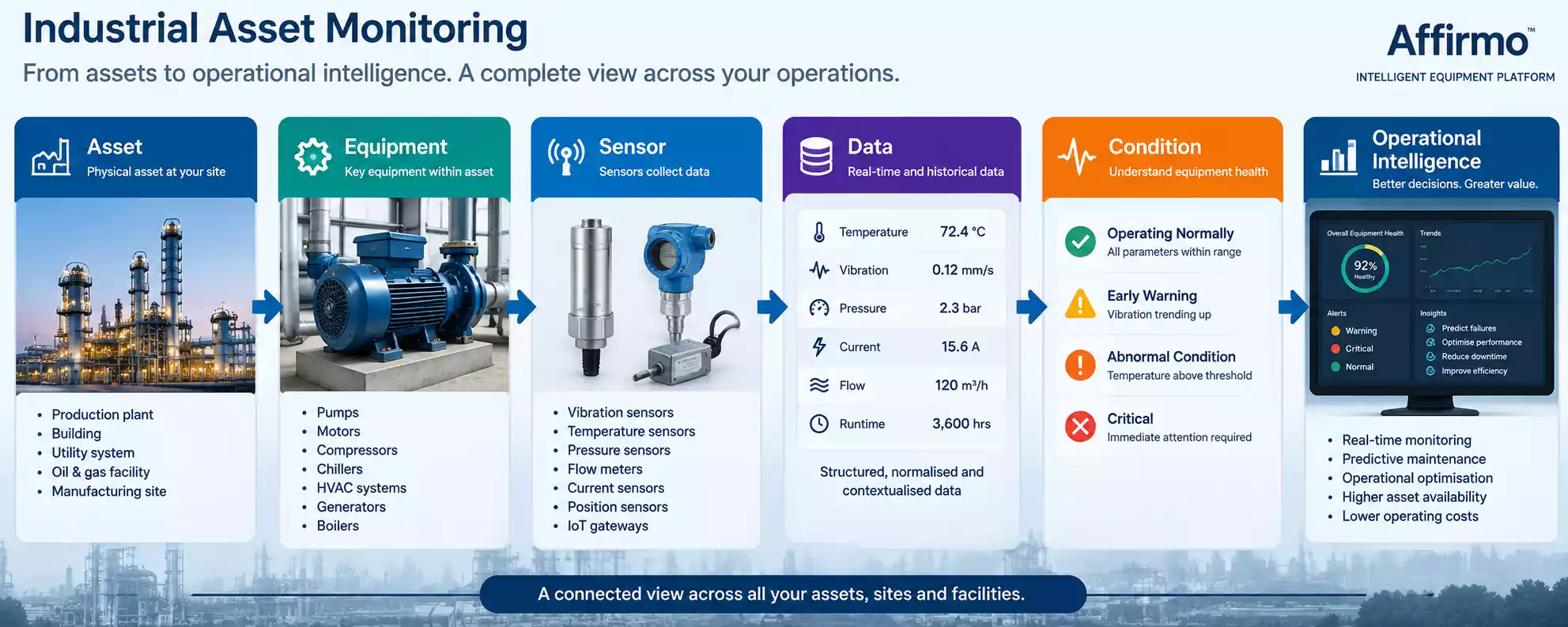
This provides a broader view across facilities and sites and supports industrial asset monitoring beyond individual machines.
Facilities and Critical Infrastructure
The same architecture can be applied across different environments, including manufacturing plants, utilities, commercial and industrial buildings, oil and gas and energy environments, defence facilities and other critical infrastructure.
Intelligent Equipment Platform and Agentic AI
Agentic AI introduces another layer to equipment intelligence.
The progression from monitoring and analytics to Predictive AI and Agentic AI can be understood as:
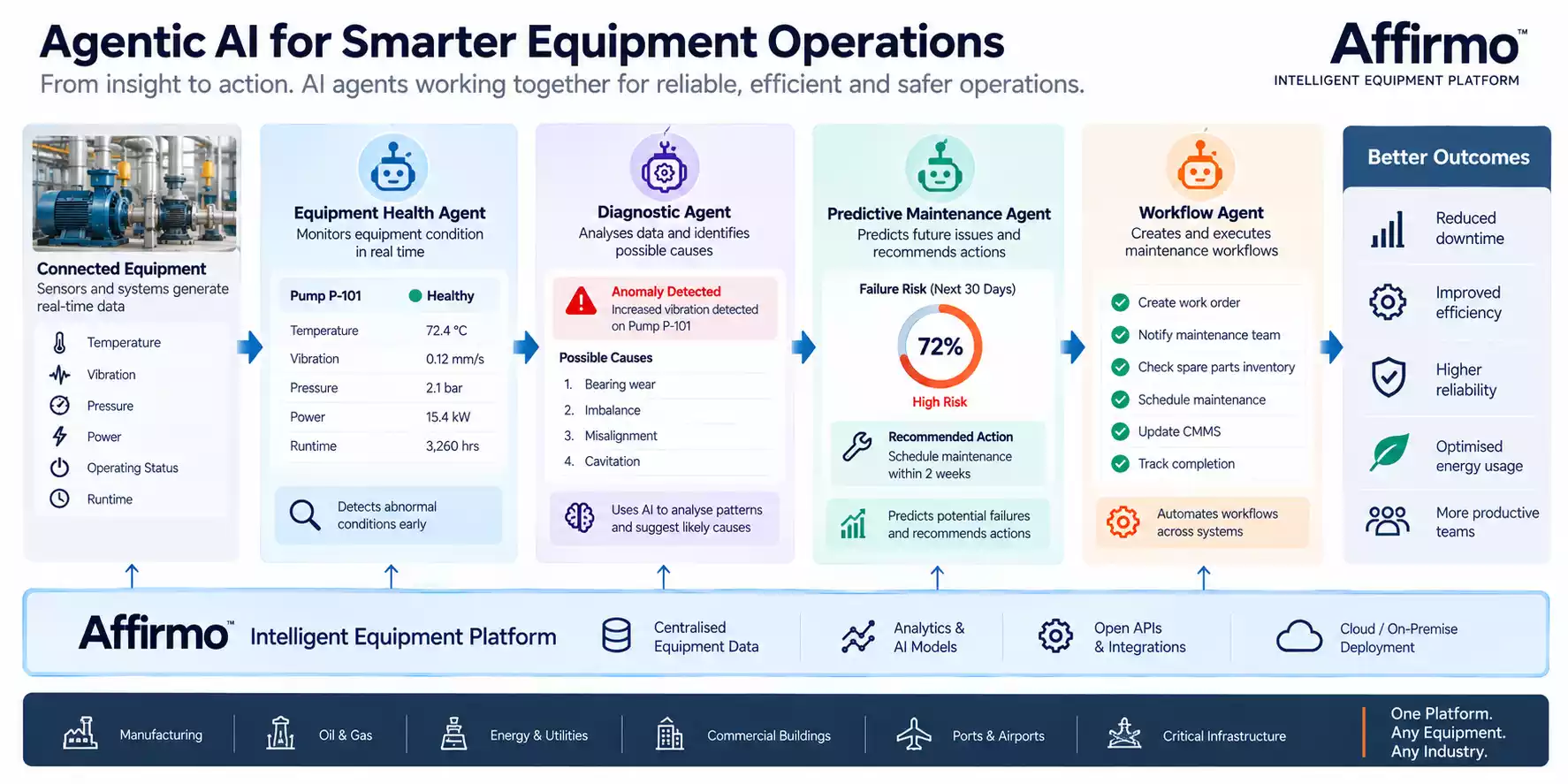
This is why the quality and structure of equipment data matter. AI agents need access to reliable, contextualised information if they are expected to reason about equipment conditions.
Potential architectures could include an Equipment Health Agent, Anomaly Detection Agent, Diagnostic Agent, Predictive Maintenance Agent, Maintenance Planning Agent, Knowledge Agent and Workflow Agent.
These are potential design patterns rather than claims about existing customer deployments.
The broader industrial market is moving in this direction. IoT Analytics reported in 2026 that enterprise IoT was entering an "agentic and AI phase," while noting that less than 1% of the 21.1 billion IoT connections at the end of 2025 had a true edge-AI component.
That gap illustrates an important point: connecting equipment is one stage. Making equipment data useful to intelligent systems is another.
|
Capability
|
Key Question |
Example Output
|
|
Real-Time Monitoring
|
What is happening? |
Equipment operating outside configured conditions
|
|
Analytics
|
What changed? |
Operating behaviour differs from historical patterns
|
|
Anomaly Detection
|
Is something unusual? |
Abnormal equipment behaviour identified
|
|
Predictive Maintenance
|
What may happen next? |
Potential maintenance requirement identified
|
|
AI Diagnostics
|
Why might it be happening? |
Possible contributing conditions identified
|
|
Agentic AI
|
What should happen next? |
Recommended workflow or action
|
|
Human Approval
|
Should the action proceed? |
Engineer or manager reviews proposed action
|
Enterprise Integration Architecture
A practical architecture can look like this:
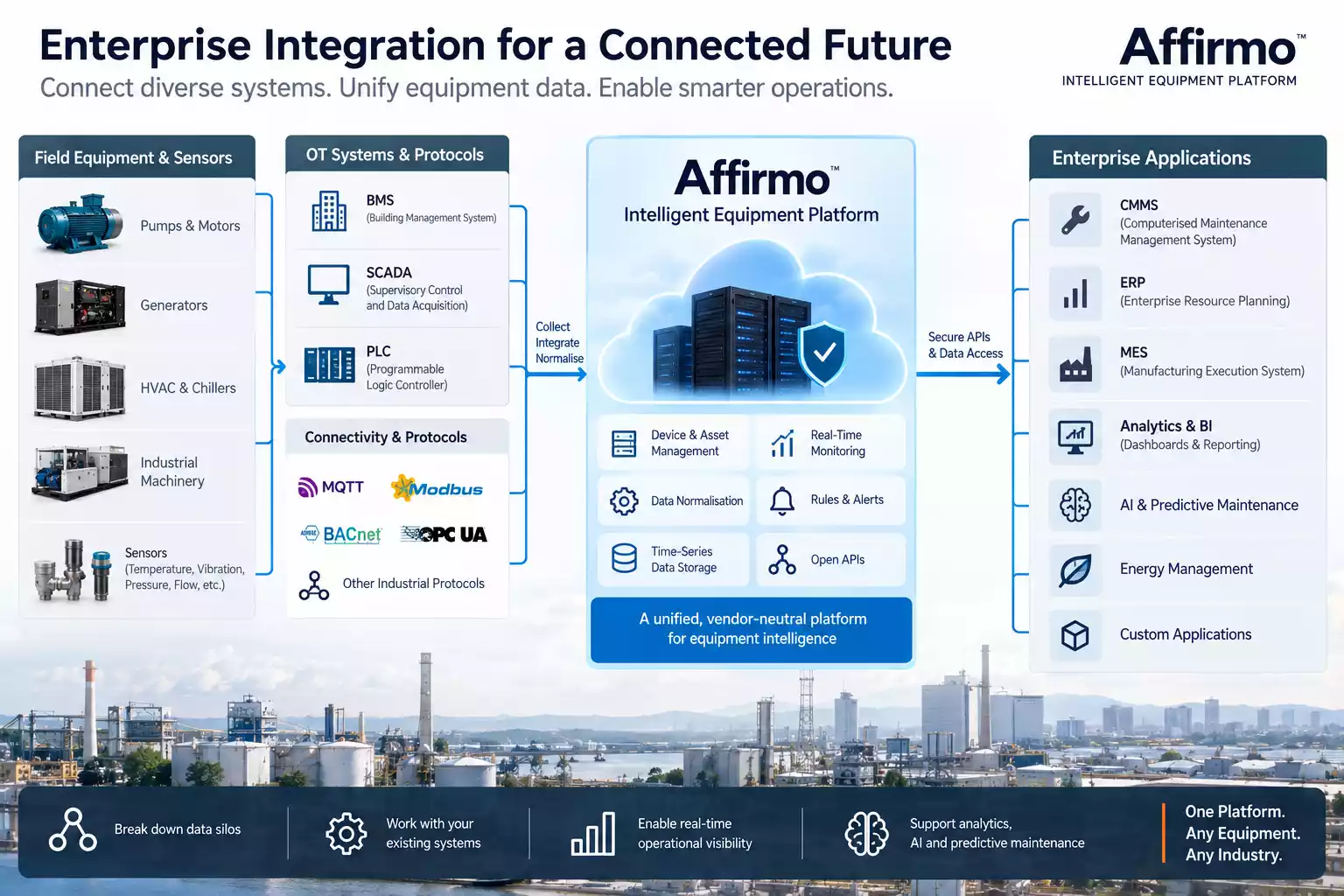
Depending on the environment, integration can involve BMS, SCADA, PLCs, Modbus, BACnet, MQTT, REST APIs, ERP, MES, CMMS and LoRaWAN, creating a foundation for Industrial AI and advanced equipment analytics.
The platform can also be deployed in cloud or on-premise environments, depending on enterprise requirements.
This approach reflects a broader direction in the Industrial IoT market. Major platforms such as ThingWorx, Siemens Insights Hub and HighByte also emphasise connecting industrial data, contextualising it and making it useful for analytics or operational applications.
Why Vendor-Neutral Equipment Intelligence Matters
Vendor neutrality becomes increasingly important as organisations operate equipment from multiple manufacturers and inherit systems from different technology generations.
A vendor-neutral IoT platform can provide a common layer for:
- Connecting different equipment
- Normalising data
- Maintaining equipment context
- Providing APIs
- Supporting multiple applications
- Preserving existing investments
The goal is not to create another isolated system. It is to make existing equipment data more accessible and useful.
Business Benefits
An effective equipment intelligence architecture can support:
- Reduced equipment downtime
- Improved maintenance efficiency
- Better operational visibility
- More informed maintenance decisions
- Improved equipment reliability
- Better asset utilisation
- Reduced unnecessary operating activity
- Easier reporting and data sharing
- A stronger foundation for AI
Affirmo's platform materials specifically identify reduced downtime, improved maintenance efficiency, operational visibility, reduced operating costs, better data-driven decisions and future AI readiness as intended benefits.