
Financial organizations already generate vast amounts of data across transactions, ERP systems, payments, customer records, compliance, and financial reporting. The challenge is turning that fragmented information into timely, explainable action.
Agentic AI can connect these data streams, investigate anomalies, assess risk, predict outcomes, and coordinate governed workflows. The shift is gaining momentum: 80.5% of surveyed finance and accounting professionals expect AI agents and GenAI to become standard tools within five years, while only 13.5% report current agentic AI use, according to Deloitte's 2025 research.
For banking, insurance and finance leaders, this creates a practical path from:
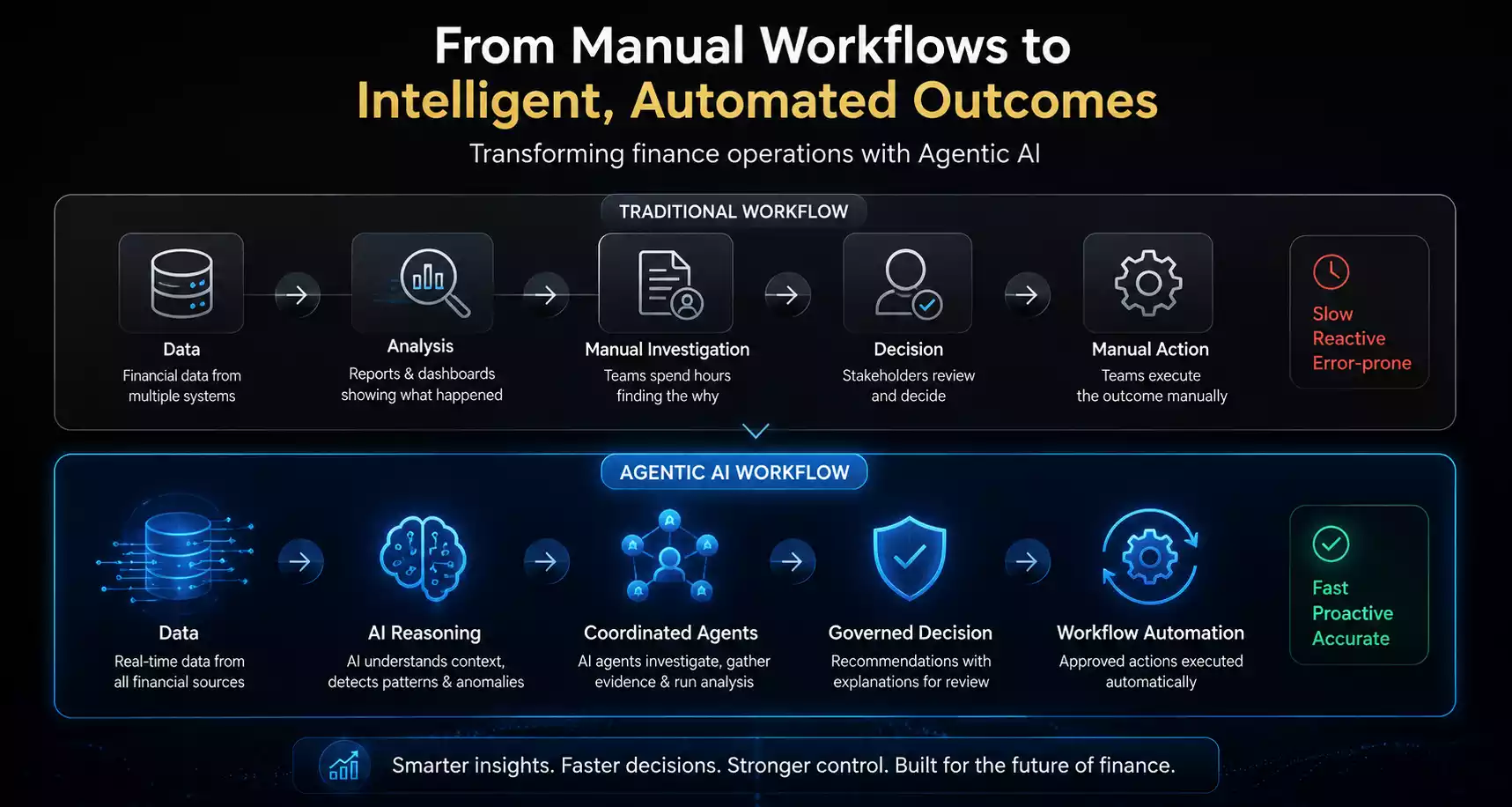
The Evidence Behind the Shift to Agentic AI in Finance
Why Agentic AI Matters for Finance
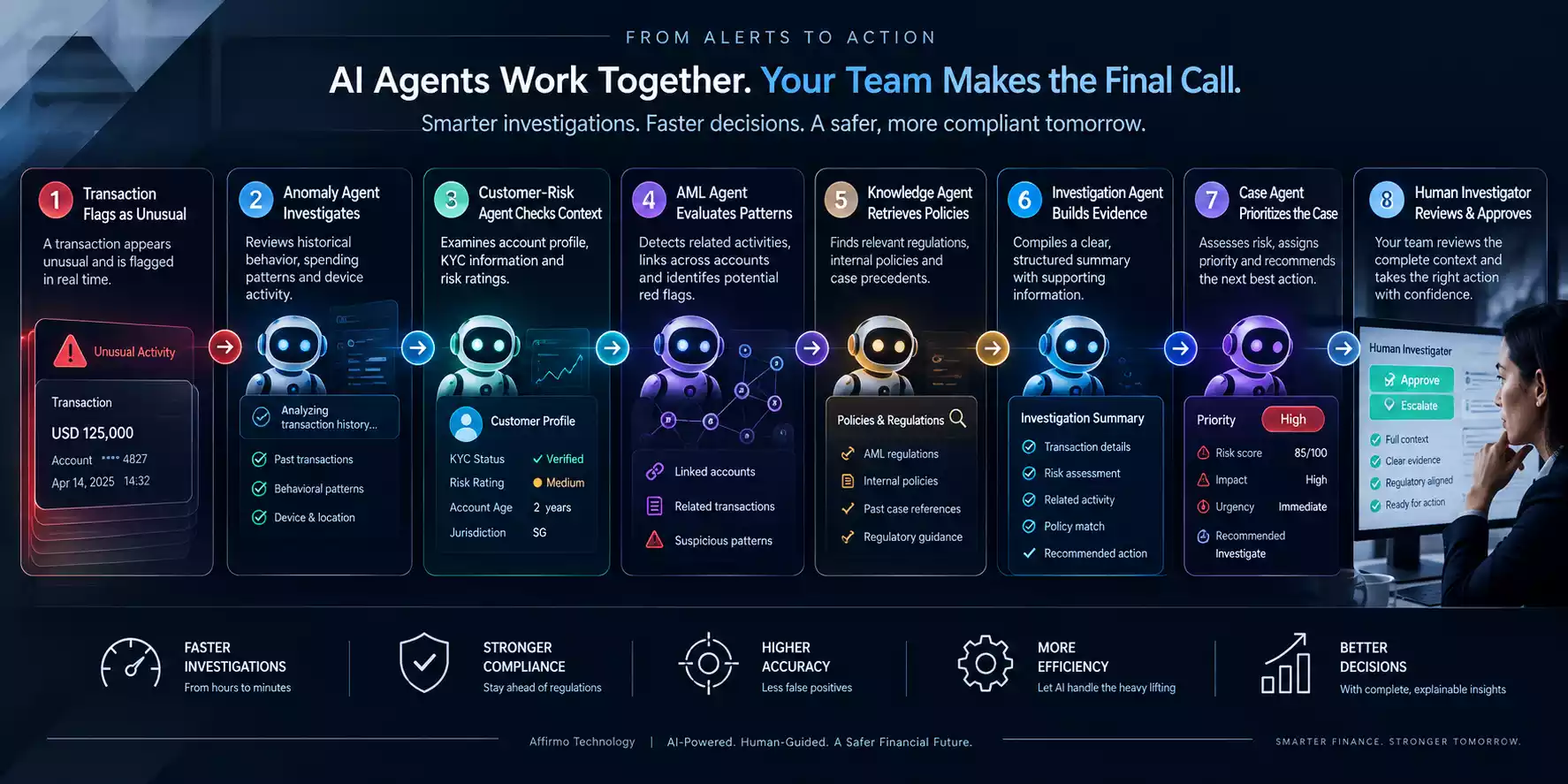
1. Agentic AI for Fraud Detection and Financial Crime Investigation
Current Situation
Banks, payment providers, digital wallets, insurers and other financial organizations process enormous numbers of transactions. Existing fraud and AML systems can identify suspicious activity, but investigations often require analysts to collect evidence from several systems.
Agentic AI Solution
An Agentic AI architecture can connect transaction monitoring, KYC, customer behavior, device signals, historical cases and sanctions information.
Specialized agents can include:
- Transaction Monitoring Agent
- Anomaly Detection Agent
- Fraud Investigation Agent
- AML Agent
- Customer Risk Agent
- Identity/KYC Agent
- Knowledge Agent
- Case Management Agent
- Reporting Agent
- Human Approval Agent
Example Workflow
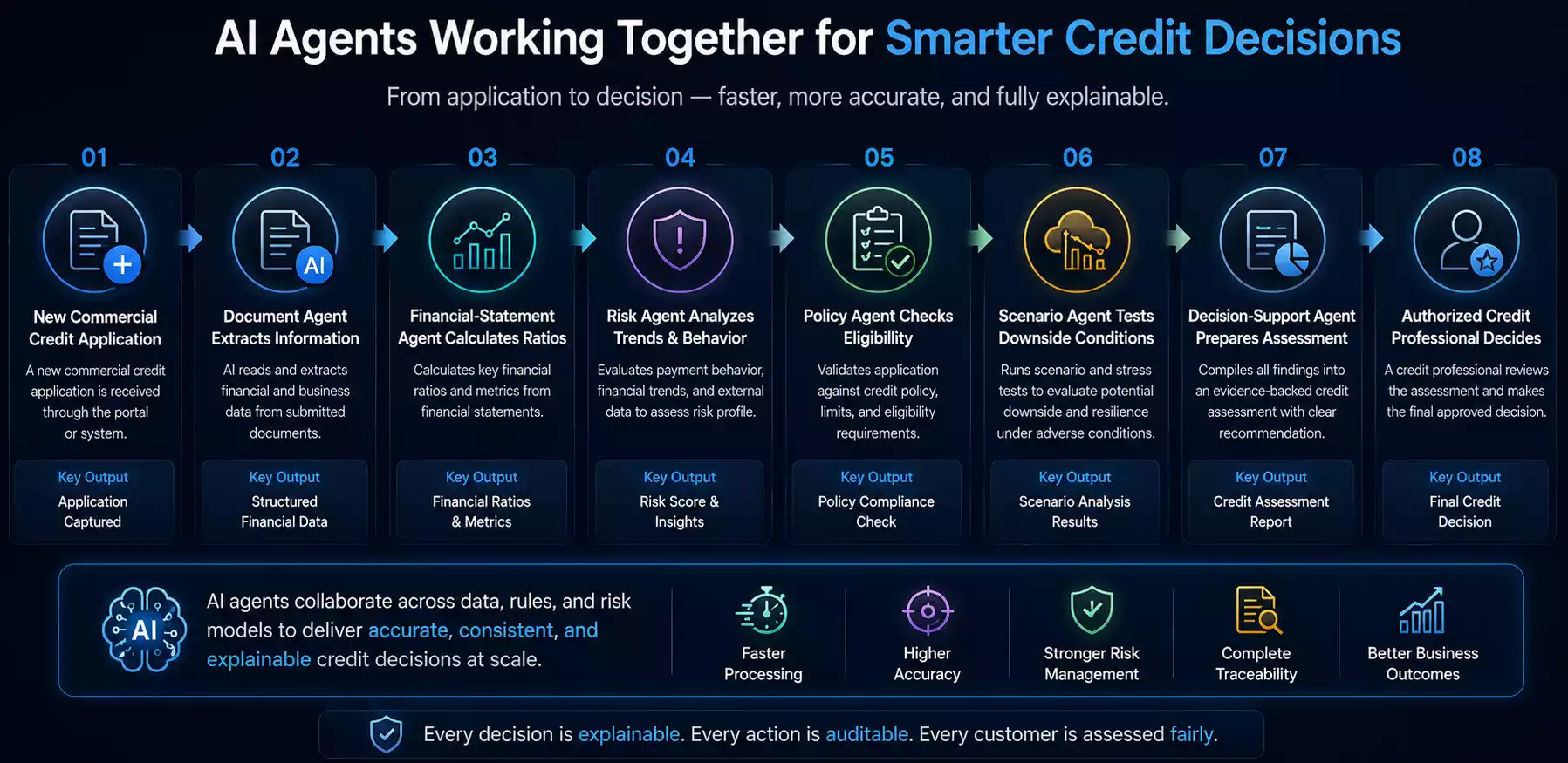
The objective is not to let AI independently freeze accounts or make irreversible decisions. It is to reduce investigation effort while improving the quality and context available to investigators.
Financial Data Sources
Transaction systems, payment platforms, KYC databases, account activity, device information, login activity, location signals, sanctions screening, previous investigations and risk-scoring systems.
Enterprise Benefits
Faster investigations, better case prioritization, stronger fraud intelligence, reduced manual research and improved AML operational efficiency.
2. Agentic AI for Financial Close, Reconciliation and Accounts Operations
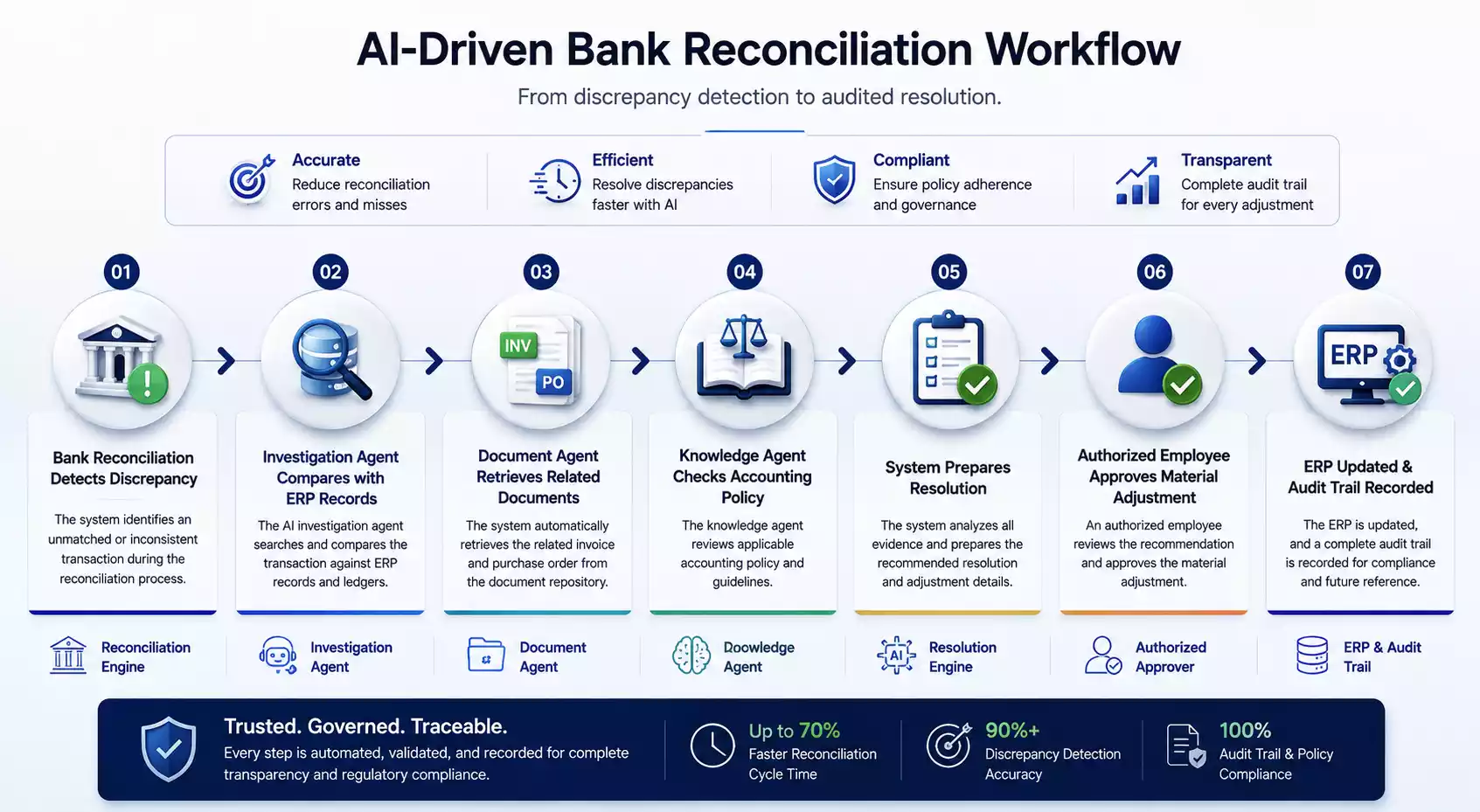
Month-end close and reconciliation can involve ERP records, bank statements, invoices, purchase orders, payment records and general ledger entries.
The problem is rarely finding a mismatch. The time-consuming part is determining why the mismatch exists and what evidence is required to resolve it.
Multi-Agent Architecture
- Reconciliation Agent: identifies mismatches.
- Invoice Validation Agent: compares invoices against supporting records.
- Document Intelligence Agent: extracts relevant information.
- Exception Investigation Agent: determines likely causes.
- Knowledge Agent: checks accounting policies.
- Financial Close Agent: tracks outstanding close activities.
- Workflow Agent: prepares approved actions.
- Approval Agent: routes material adjustments to authorized personnel.
- Reporting Agent: creates audit-ready summaries.
Example Workflow
Enterprise Benefits
- Faster reconciliation
- Less repetitive manual work
- Shorter close cycles
- Better exception management
- Stronger audit trails
- Improved financial-control visibility
3. Agentic AI for FP&A, Forecasting and Cash Flow Intelligence
Financial planning becomes difficult when forecasts change faster than finance teams can investigate the reasons behind the changes.
Agentic AI can continuously monitor financial performance and investigate variances across revenue, expenses, receivables, inventory and operating costs.
AI Agents
- Forecasting Agent predicts financial outcomes.
- Variance Analysis Agent identifies deviations from budgets and forecasts.
- Scenario Agent models alternative business conditions.
- Cash Flow Agent evaluates liquidity implications.
- Revenue Intelligence Agent investigates sales and customer trends.
- Risk Agent identifies emerging financial risks.
- Executive Reporting Agent converts analysis into management-ready summaries.
Example Workflow
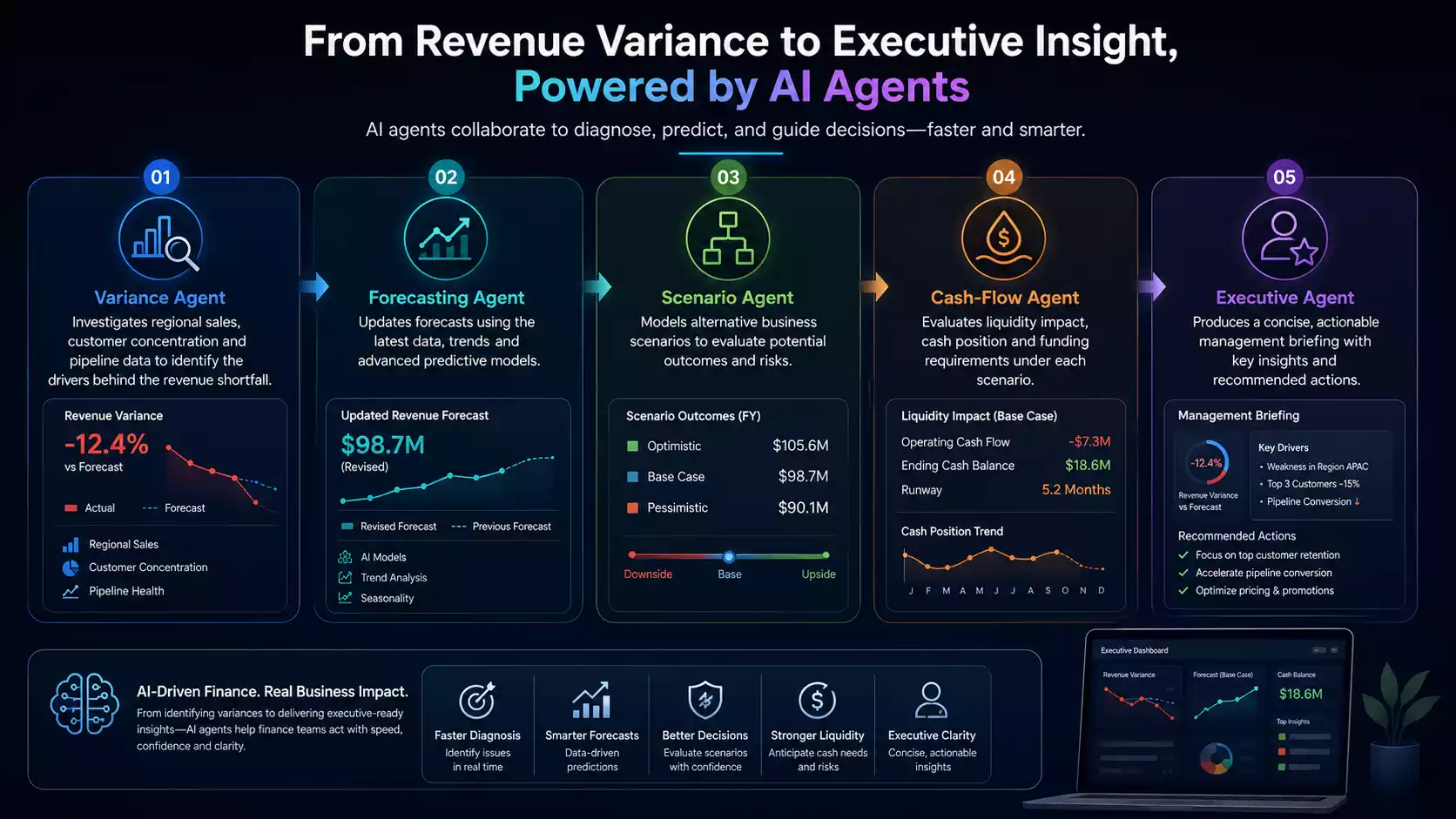
The CFO and finance team remain responsible for decisions. AI provides the continuous analysis and scenario intelligence needed to make those decisions faster.
Data Sources
ERP, general ledger, CRM, sales pipeline, accounts receivable, accounts payable, inventory, payroll, financial statements, market data and economic indicators.
Enterprise Benefits
Better cash-flow visibility, faster variance analysis, more responsive forecasting, stronger scenario planning and improved management reporting.
4. Agentic AI for Credit Risk and Underwriting Decision Support
Credit analysis often requires banking, insurance and finance professionals to review financial statements, payment behavior, business information, risk models and internal policies.
Agentic AI can coordinate this analysis without turning the lending decision into an uncontrolled automated process.
AI Agents
- Credit Analysis Agent
- Financial Statement Agent
- Risk Assessment Agent
- Document Intelligence Agent
- Fraud Detection Agent
- Policy Compliance Agent
- Scenario Analysis Agent
- Knowledge Agent
- Decision Support Agent
- Human Approval Agent
Example Workflow
This approach can accelerate analysis while maintaining explainability, auditability, approval thresholds and human oversight.
BIS research identifies credit scoring, collateral valuation and analysis of unstructured information as established areas where AI can support financial institutions.
Enterprise Benefits
- Faster credit assessment
- Reduced analyst workload
- More consistent analysis
- Better document processing
- Stronger policy compliance
- Improved decision preparation
5. Agentic AI for Financial Compliance, Risk and Regulatory Reporting
Compliance teams must continuously interpret regulations, monitor transactions, investigate cases, maintain evidence and prepare reports.
The challenge becomes particularly complex when regulatory requirements change while financial institutions operate across multiple jurisdictions.
AI Agents
- Compliance Monitoring Agent
- Regulatory Intelligence Agent
- Policy Analysis Agent
- Transaction Risk Agent
- Investigation Agent
- Evidence Collection Agent
- Knowledge/RAG Agent
- Audit Agent
- Reporting Agent
- Human Approval Agent
Example Workflow
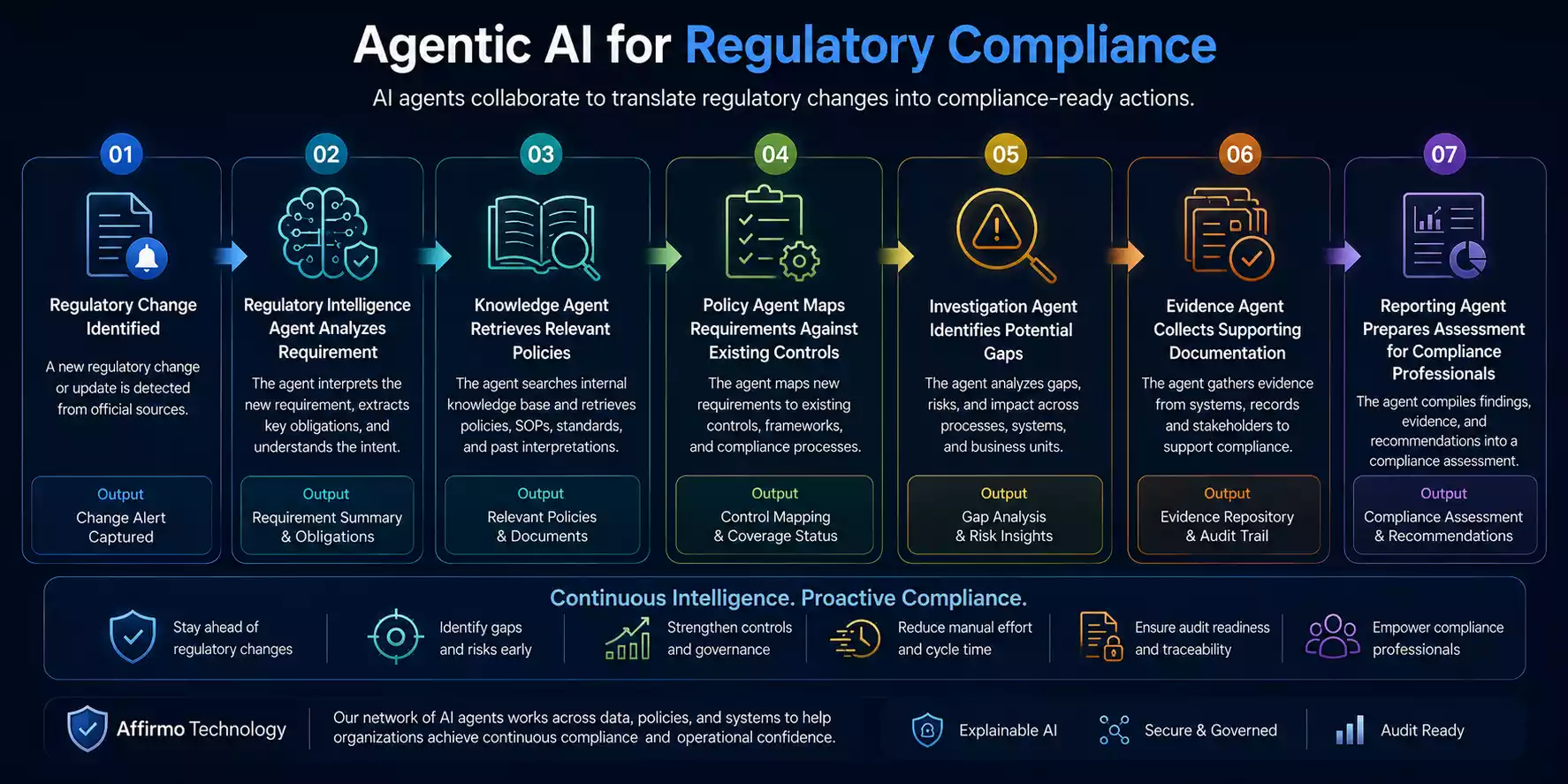
The objective is not to replace compliance officers. It is to reduce the manual research and documentation burden surrounding their work.
FATF has highlighted the potential for advanced analytics and technology to improve the speed, quality and efficiency of AML/CFT activities, while emphasizing appropriate privacy and legal safeguards.
Enterprise Multi-Agent Architecture for Banking, Insurance and Finance
Data Layer
ERP, core banking systems, payment platforms, CRM, financial databases, transaction systems, document repositories and data warehouses.
Integration Layer
REST APIs, enterprise APIs, SQL databases, event streams and cloud integration services connect operational systems.
Agent Layer
Monitoring, anomaly detection, prediction, investigation, financial analysis, Knowledge/RAG, workflow orchestration, reporting and notification agents collaborate around specific business objectives.
Governance Layer
Identity controls, audit trails, data lineage, model monitoring, approval policies, security and human oversight govern what agents can access and execute.
Customers


Singapore is particularly relevant because financial institutions operate in an environment where digital banking, payments, FinTech, cross-border transactions and regulatory technology are developing rapidly.
The opportunity extends across Malaysia, Indonesia, Thailand, Vietnam and the Philippines, where financial institutions and banking, insurance and finance teams are modernizing payment operations, risk management, compliance and digital services.
For Singapore-based organizations, governance is especially important. MAS has been increasing attention on AI risk management as financial institutions expand AI usage, with concerns including model, data, technology and third-party risks.

Agentic AI therefore needs to be approached as an enterprise architecture and governance initiative, not simply an LLM deployment.
Contact Us
6 Ubi Road 1 #05-01
Wintech Centre
Singapore 408726